by KenBay | Dec 18, 2018
Challenge: Reduce the cost of hauling waste to the nearest Waste to Energy facility to make the process cost effective.
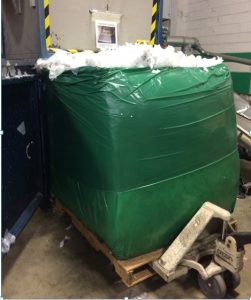
Solution: Use the RotoPac with its high compaction ratio to package the waste into 4’ cubes for cost effective transport.
Result: Making the process of hauling waste that here-to- for could not be cost effectively transported long distances to a Waste to Energy facility for incinerating it into energy bricks.
by KenBay | Dec 18, 2018
It won’t come as any surprise to most folks that bulk waste has high associated disposal costs. We’d like to share a story about a West Coast Aircraft Service Facility client of ours who serves the aircraft industry and the waste they produce is considered hazardous, which adds a whole additional level of complexity to the situation! The story begins with the switch to a Cubic Yard Box!
 Jim Kirby works in Paint Operations; the paint masking material contains chrome related primers and requires a Class 1 Fire Protection Unit. Their operations used to consist of using a RotoPac® they rented from KenBay along with a 40 yard roll-off bin. The first round of compaction was done in 55 gallon metal drums, compacted again in the RotoPac and the waste was shipped to their hazardous waste vendor in Tennessee who would put the waste into a cubic yard box and ship the boxes to fuel blend. There were several associated costs with this approach, and as you can imagine, those costs quickly added up to a big expense.
One day their hazardous waste vendor made a change that sparked a huge savings for Jim’s company. They started requiring the waste be put into a hazardous waste rated cubic yard box instead of the bags they had used historically. It was important to find the most efficient way to accommodate this change. Since there was already collaborative relationship with KenBay and they were already renting a RotoPac, it made sense to start with KenBay. Don Meis, the founder of KenBay spent time researching the new requirements and he presented a simple solution. There was a way to outfit the RotoPac so that it could compact waste directly into the cubic yard box.
 The modification included the following:
- Remove the protection shield
- Stabilize the Unit to ensure the cubic yard box doesn’t move during compaction
- Use a shorter RotoPac drum
- Install guard rails to prevent the boxes from expanding as waste was compacted
That did the trick!
So their old process which required 55 gallon metal drums, a 40 yard roll-off bin, liners, transport to Tennessee and finally shipping in a cubic yard box to fuel blend, was all reduced to onsite waste compaction indoors without exposing the environment to the hazardous waste, with better logistics, better security and lower costs!
We mentioned 90% savings. Can that be true? Let’s take a look at the numbers:
- For the first 6 months of 2015, the costs utilizing the 40 yard roll off and shipping to TN prior to shipping to fuel blend totalled $141,000
- For the second 6 months of 2015, the costs of using a customized RotoPac, compacting on-site and shipping to fuel blend on the west coast totalled $14, 500
- An annual savings of $126,500!
The great part of this story is how they captured all associated costs and eventual savings as a result of making a few changes to their RotoPac compactor. How many of us pay the bills on a monthly basis without wondering how things could be done smarter and more cost effectively?
The costs for the old process came from various sources:
- 55 gallon metal drums
- The roll-off bin had to be kept outdoors, required a lid and regular maintenance and it took up a lot of physical space.
- Liners for the RotoPac
- Labor of transporting waste from paint operations to the outdoors where the 40 yard roll off was kept
- Pulls from the 40 yard roll-off bin cost $20k per pull and they averaged 10 pulls per year.
- Paying the hazardous waste vendor for the labor, fuel and materials required to put waste in a cubic yard box, blend and ship.
In 2016 Jim decided it was time to stop renting the RotoPac from KenBay and purchase it outright and he hasn’t looked back! Contact us at KenBay. Explain your specific sources of waste and we’ll recommend a process that is safe, efficient and cost effective. It would be our pleasure!
by KenBay | Dec 18, 2018

- Challenge: Maker of luxury sea craft needed to reduce the number of workers associated with trash removal to reassign them to other tasks.
- Solution: The RotoPac industrial waste compactor is situated at the source of the waste. At the plant they have placed two rotary arm compactors, the RotoPacs directly on the assembly line and one in the distribution center to manage the 60 tons of trash.
- Result: Reduced disposal costs, labor hours and workplace accidents. Prior to this dumpsters had to be emptied eight to ten times a day by two forklift operators who emptied the smaller dumpsters into a larger open-top dumpster at a remote location. Now trips to the dumpster have been significantly reduced. Also an added benefit of reducing forklift traffic within the facility is that a safety concern has been alleviated. Client indicates that the RotoPac is easy to install and does not require a full-time operator like a baler does. They were able to reduce staff hours and pay for the RotoPacs within a year.
(more…)
by KenBay | Dec 18, 2018

- Challenge: Client had voluminous amount of paper products and improperly made filters. The extra paper accumulation was so bad that it was blocking their distribution docks by constantly transporting dumpsters to be emptied. They had 6 dumpsters throughout the plant that were being dumped 32 times per day.
- Solution: Now the RotoPac bags are removed 5 or 6 times per day.
- Result: By reducing the forklift travel they reduced the maintenance on their fleet, picked up more plant floor space to use in production and calculated $52,000 annual savings in fork lift operator costs.
(more…)
by KenBay | Dec 18, 2018

- Challenge: Their production assembly floor was being clogged by large amounts of cardboard dunnage discarded from receiving components. Removal of the waste materials required fourteen trips daily to move and empty the full collection hoppers to the rear of the facility.
- Solution: They installed a RotoPac and placed it at the source of the waste, right on their production assembly floor.
- Result: Not only have they reduced the amount of trips necessary to remove the cardboard to one a day, but it has also resulted in annual saving of 50% more than the cost of the RotoPac.
(more…)
by KenBay | Dec 18, 2018
- Challenge: The facility generates a huge amount of trash, disparagingly referred to as Foreign Object Debris (F.O.D.), considered lethal to an aircraft.
- Solution: Client purchased approximately 50 RotoPac™ industrial waste compactors and placed them throughout the production area.
- Result: They are able to compact at a 10-1 ratio (customer’s figure) saving money and personnel needed to handle the volume of F.O.D. Under the current system, trash removal has gone from as much as six times a day to only once a day. The company’s move to the Rotary Arm Compactor, the RotoPac™ has enabled production workers to concentrate on the manufacturing process and not waste handling.
The RotoPac™ industrial waste compactor has a 4-ft. x 5-ft. footprint equal to one of the metal trash boxes it replaced. That meant a significance savings of valuable shop space as one plastic bag of compacted trash equaled 10 boxes. Client places great emphasis on employee safety and the introduction of the “at-the-source” compactor has virtually eliminated the risk of injuries created by the heavy metal carts. The RotoPac industrial waste compactor is a very safe and easy to use compactor, requiring minimal training and allows production personnel to work on assembling aircraft, not carting away trash.
(more…)
by timm | Jul 10, 2018
Improvements in the RotoPac
KenBay has recently made a number of significant enhancements and improvements to their worldwide workhorse industrial waste rotary compactor, the RotoPac to keep pace with changes in the marketplace. With increase demand over the last year, KenBay found it necessary to upgrade to a manufacturing partner who could meet the demand while continuing to upgrade, improve and enhance our compactors to achieve customer’s zero waste objectives.
The RotoPac was designed over 20 years ago in Ireland to provide maximum waste compaction (6 to 1) with a small footprint (51” x 61”) in the space-starved manufacturing facilities of Europe. This was achieved through the unique design of a distributor that provided hydraulic power to a drum that continually rotated and swept, ultimately applying continuous compaction to waste through higher than expected torque. The waste is compacted in polyethylene bags on average weighing over 500 lbs. Its design was made simple to use and maintain, delivering longevity of use.
Since its inception, thousands of RotoPac Industrial Waste Compactors have been installed worldwide, usually by repeat customers in various facilities and warehouse location because of the machine’s ability to deliver on it promises — achieving and exceeding its design goals. Many enhancements and improvements have been made over the years resulting in a range of compactors for many different applications and different environments. Our compactors are now made exclusively in North America for the global market.
Not all the enhancements and improvements made to the RotoPac over the past year can be shown in pictures. However, the following pictures show just one simple improvement where the electronic controls were separated from the hydraulics to reduce maintenance and improve accessibility to each.
Enhancements to the RotoPac 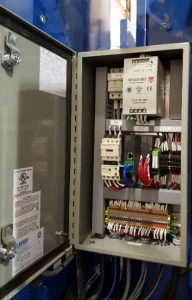
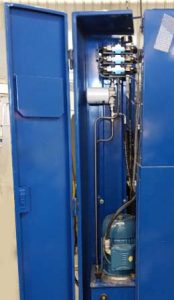
Many enhancements made to the RotoPac this past year that improve ease of use, longevity and operational integrity are listed below:
- Increased chrome hardening of distributor shaft and significantly improved seals
- PLC provides relay that allows the RotoPac to automatically synch up with other equipment such as a trim system or conveyor.
- UL Listed Panels to exceed standards
- 24 Volt DC control voltage
- PLC with HMI touch screen provides increased functionality
- User friendly simplified controls
- Powder coated paint throughout
- Category 2 Safety Circuit
- Interior 90 degree angles have been changed to eliminate dust gathering
- New push button station, which is now a PLC, is integrated into the main cabinet.
- Rear tower now descends to the floor for greater strength and stability.
- Rear cabinet doors have been redesigned for greater structural integrity.
Loading door hinges are behind walls to remove dust gathering on them.
by timm | May 24, 2018
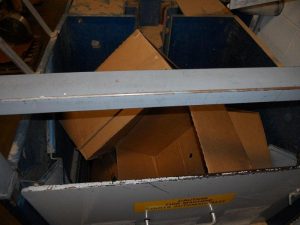 Online shopping has exploded in the last decade. The instant gratification coming from purchasing products at home or at work has its consequences though. The ubiquitous cardboard boxes that appear on front steps throughout the country have to go somewhere when no longer needed. And with the economic downturn as of late in the value of recycled paper materials, cardboard recyclers have to get creative to improve their bottom line. Chinese buyers are getting pickier when it comes to contaminates in bales of cardboard, pressboard and general paper. The dilemma for manufacturing companies across the globe is to efficiently remove cardboard from their waste stream, economically compact it and provide recyclers with a clean product.
Whether it’s helping prepare cardboard for the recycling station or giving other great tips, KenBay is committed to providing key recycling solutions. We offer a wide range of compactors to you for cardboard and other kinds of waste. For more information, visit our website.
Let’s Witness Proper Cardboard Recycling
Saving Space in the Production Area
One of the world’s largest producers of medicine and vaccinations for pets and livestock recently started using the KenBay Industrial Trash Compactor and recycling unit for compacting their waste. As shipments come into the facility, boxes in which they come, are emptied before the incoming items are moved to the production area. Packaging is not permitted in the production area where animal medicines are made.
Reducing Packaging Collecting Costs
Prior to installing the RotoPac the cardboard boxes were broken down and placed on a pallet. At the end of each day the pallet was moved to the recycler’s truck by forklift. With the RotoPac, most of the boxes are thrown into it without having to be broken down manually; they are compacted into polyethylene bags.
Making it Cost Effective
Now the compacted cardboard, on average weighing 550 lbs. per bag, is moved to the recycler’s truck not having to break down most boxes and reducing the times the cardboard is moved to the truck, significantly reduces labor costs and improves safety in two ways.
Reducing Accidents and Forklift Traffic
Accidents are prevented by not having to use a knife for breaking down the majority of boxes and forklift traffic is reduced.
KenBay Helps Your Cardboard Get There
One of the best ways to recycle your cardboard is through our RotoPacs. RotoPacs not only are safe, easy, and offer continuous compaction, they deliver even more! They’re portable and very easy to move around your facility. You can put them right at the source of your cardboard waste. That way, you reduce clutter and improve overall safety even further. If you would like to try out a KenBay RotoPac for yourself, you can try one before you buy one. Simply pay a small fee and we’ll send one to your location. Best of all, there’s no complicated process if you want to keep it for life. Simply pay the rest of the full price, and it’s yours!
by timm | Jan 29, 2018
 Do you have facility costs that you haven’t factored into your bottom line? Every production facility has waste. It’s unavoidable. But knowing how to adequately reduce its footprint, its hauling cost and potential for possible injuries can make all the difference in the world. If you have cardboard boxes coming into your production area filled with components or supplies and you are still breaking them down by hand, you have room for improvement. Cardboard is recyclable. It’s also messy if not properly dealt with at the point of taking out components. If you’re chasing after savings in your facility by parring down production costs, it might make sense to first examine how you are dealing with excess cardboard.
It’s Simple…Reduce Costs That Are Adding Up
Does dispersing components/supplies received add to the problem of disposing of the packaging materials in your plant? Some areas may be in foods or medicines processing areas where disposing of the packaging there is not permitted. Many locations that receive components/supplies may not have the space there, especially if it is expected to separate the trash from the packaging that can be recycled. In addition, unpacking on the production line may have an effect upon production.
What You Can Do to Reduce Facility Costs
An effective way to solve these problems may be to consider unpacking components where they are received. This can have a number of the following benefits:
- Save space in the production area
- Reduce the cost of collecting the packaging material
- Make it more cost effective in compacting for disposal of the packaging material
- Reduce traffic of persons and/or forklifts in the plant
KenBay has been providing companies with the ability to package the materials more cost effectively by reducing labor and achieving much higher compaction.
Turn to KenBay for a Better Compactor
There’s a lot of compactor options out there to reduce your facility costs. It may be tempting to think that bigger is better. But buying a large bulky compactor is no guarantee of power. Instead, why not try one of KenBay’s RotoPacs? The RotoPac is portable, so you can transport it easily across the floor to wherever you need. Put it right at the source of your waste for maximum effect. And you can bet that the RotoPac has a fantastic compaction rate! If you want to try out a RotoPac for yourself, visit our website to try one out for yourself. You’ll be impressed at it’s power . . . and your savings!
by timm | Oct 9, 2017
It All Started with a Cubic Yard Box
It won’t come as any surprise to most folks that bulk waste has high associated disposal costs. We’d like to share a story about a West Coast Aircraft Service Facility client of ours who serves the aircraft industry and the waste they produce is considered hazardous, which adds a whole additional level of complexity to the situation! The story begins with the switch to a Cubic Yard Box!
Jim Kirby supports a Paint Hangar Operations; the paint masking material contains chrome related primers and requires a Class 1 Fire Protection Unit. Their operations use a RotoPac® they rented from KenBay along with a 40 yard roll-off bin. The first round of compaction was done in 55 gallon metal drums, and shipped to their hazardous waste vendor in Tennessee for fuel blend. In addition, the larger materials would be compacted in the RotoPac and then shipped to a local waste vendor and then repackaged into a cubic yard box and ship to Tennessee for fuel blend. There were several associated costs with this approach, and as you can imagine, those costs quickly added up to a big expense.
One day their hazardous waste vendor made a change that sparked a huge savings for Jim’s company. They started requiring the waste be put into a hazardous waste rated cubic yard box instead of the drums and the cubic yard bags they had used historically. It was important to find the most efficient way to accommodate this change. Since there was already collaborative relationship with KenBay and they were already renting a RotoPac, it made sense to start with KenBay. Don Meis, the founder of KenBay spent time researching the new requirements and he presented a simple solution. There was a way to outfit the RotoPac so that it could compact waste directly into the cubic yard box.
The modification included the following:
- Remove the protection shield
- Stabilize the Unit to ensure the cubic yard box doesn’t move during compaction
- Use a shorter RotoPac drum
- Install guard rails to prevent the boxes from expanding as waste was compacted
That did the trick!
So their old process which required 55 gallon metal drums, a 40 yard roll-off bin, liners, transport to local waste vendor and finally shipping to Tennessee in a cubic yard box to fuel blend, was all reduced to onsite waste compaction indoors without exposing the environment to the hazardous waste, with better logistics, better security and lower costs!
We mentioned 83% savings. Can that be true? Let’s take a look at the numbers:
- For the first 6 months of 2015, the costs utilizing the 40 yard roll off and shipping to TN to fuel blend totaled $86,000
- For the second 6 months of 2015, the costs of using a customized RotoPac, compacting on-site and shipping to TN fuel blend totaled $14, 500
- An annual savings of $71,500!
The great part of this story is how they captured all associated costs and eventual savings as a result of making a few changes to their RotoPac compactor. How many of us pay the bills on a monthly basis without wondering how things could be done smarter and more cost effectively?
The costs for the old process came from various sources:
- 55 gallon metal drums
- The roll-off bin had to be kept outdoors, required a lid and regular maintenance and it took up a lot of physical space.
- Liners for the RotoPac
- Labor of transporting waste from paint operations to the outdoors where the 40 yard roll off was kept
- Pulls from the 40 yard roll-off bin cost $15 per pull and they averaged 10 pulls per year.
- Paying the hazardous waste vendor for the labor, fuel and materials required to put waste in a cubic yard box, blend and ship.
In 2016 Jim decided it was time to stop renting the RotoPac from KenBay and purchase it outright and he hasn’t looked back! Contact us at KenBay. Explain your specific sources of waste and we’ll recommend a process that is safe, efficient and cost effective. It would be our pleasure!