
By KenBay on Jan 25, 2023, 10:05:56 AM

The two primary objectives of increasing a manufacturing facility’s ROI (Return On Investment) in regards to using an on-site industrial waste compactor are to reduce labor and hauling costs. When employing the optimal compactor for any specific application, a company can see an ROI in one to two years incorporating certain factors.
Investing in Waste Compaction Machinery
 Most industrial compactors are designed to provide cost savings by compressing removed waste and thus allowing more workspace and freeing up labor time. But to get maximum savings it is necessary to consider such things as the initial cost of a facility’s industrial compaction machinery, what is its rate of compaction, where inside or outside the company’s facility to locate the compactor, how the waste is inputted into the compactor and does the industrial waste compactor need to be modified in some way to more efficiently allow refuse to be input prior to compaction.
Improving Labor Efficiency
Let’s look at different ways in which labor can be reduced. Depending upon the material being compacted, labor efficiency can be improved by not having to break down cardboard boxes, by blowing continuous strips of paper material directly into the compactor from a label-making machine, conveying material from production into the compactor or by tossing bags/50 lbs. sacks of grains and ingredients into a chute leading into a facility’s compactor.
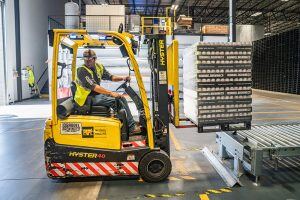
Forklift operator time can be saved by optimally placing the compactor so that the minimum distance required for taking waste to the compactor is reduced as well as when removing waste from the compactor and transporting it to the hauler’s container.
A Different Approach
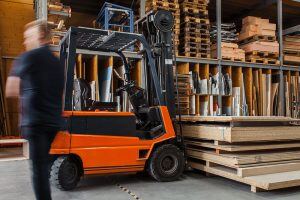 Only some of the aforementioned features can be achieved by traditionally RAM industrial compactors. But all of the above features can be realized by rotary compactors such as the KenBay RotoPac because of its small footprint (4’x5’) saving on floor space. Compactors using large containers (generally referred to as “cans”) are not flexible enough to take advantage of some of the numerous ways of getting waste into a compactor to save labor. This also has the added feature of improving workplace safety. With less distance a forklift has to travel, the less opportunity of forklift accidents (which accounted for over 7000 non-fatal workplace injuries in 2020 alone) have to occur.
Having a waste compactor with a high rapid waste compaction rate, e.g., 1 to 2 tons per 8 hour shift with a 6 to 1 volume reduction, will exceed most needs to provide very significant cost savings in transporting waste and recycled materials.
Higher Compaction Rates Instantly Improves ROI
 Having high compaction rates generally is the most contributing factor in reducing total waste hauling and disposal costs. Ultimately, fewer haul-offs are necessary proportional to a waste compactor’s advertised compaction rate. Landfill fees are also reduced. One can expect, on average, just over one year return on investment. Of course, every waste disposal application is different depending on the compactor, the materials being compacted, etc.
A Unique Take on Compacting Industrial Waste
The KenBay RotoPac Industrial Waste Rotary Arm Compactor was designed with a small footprint, high waste capacity and the compaction ability any facility needs to handle multiple applications, whether your site is working with large volumes of trash, plastics for recycling, hazardous waste or cardboard. Purchasing a rotary arm compactor such as the RotoPac provides for a safe alternative to the larger RAM compactors available because the KenBay compactor needs no skilled operator or designated supervision to operate. And with state-of-the-art safety features, the RotoPac is ideal in hitting the target of any organization’s waste compactor ROI goals.
Planning For An Industrial Trash Compactor in Your Facility
How Rotary Industrial Trash Compactors Save Labor Time