By timm on Jun 13, 2017, 2:37:52 PM
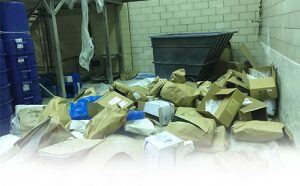 Bakeries, ingredient processing companies, the granary and feed industry, among many other high and medium volume industries receive content in 50 lbs. bags. The bags are generally made of paper lined or reinforced with plastic. Problems these emptied bags create are the following
- They are made of mixed materials, i.e., plastic and paper make them unfeasible to easily and properly recycle.
- Large volumes of bags require wasted hours of physical labor & forklifts to transport bags to waste compactor, especially to stationary compactors or dumpsters.
- Getting the bags transported and compacted to reduce hauling costs can be somewhat labor intensive.
The factors affecting the disposing of these 50 lbs. bags are that the bags need to be greatly compacted and it is highly desirable that it be done where the bags are emptied.
Compacting Bags Where They are Emptied
- The person handling the bags can throw the empty bags into the compactor located at the waste’s source without moving after emptying its content into a mixer or another machine. He/she will be the last person touching the bags in the disposal process. If a machine is used to open and empty the bags it can deposit the bags directly into the compactor. The compacting process is best accomplished with the use of a continuous compactor rather than a type of baler.
Dealing with the Dust
- Frequently the residue left in the bags creates a great deal of dust, especially in some instances near where food is being processed. A dust collector can be utilized to remove the dust from the environment from the chute in which the bags are thrown passing to an enclosed chamber compactor. Or dust collection can be done from the enclosed chamber. Compacting 50 lbss. bags into large plastic bags that can be sealed for transport also reduces ambient dust.
Reducing Labor & Hauling Costs:
- Costs are reduced with fewer trips either using a pallet jack or a forklift to remove the waste filled bag from the compactor to the hauler’s container outside. The waste filled bags contain approximately 800 50 lbs. bags. Contrast this to frequent trips hauling between 100 and 200 bags loosely placed on a pallet being hauled by forklift. Reducing forklift traffic on a factory floor is always a good thing in a number of ways, such as, safety, maintenance and cost reduction.
- One meter cubes of plastic filled waste are easily manageable for transporting either in a dumpster to landfill or in a covered trailer with double stacked bags to a Waste to Energy facility. Reducing the cost of transport of waste is critical to profitability in all types of waste disposal whether it be to landfill, recycling or Waste to Energy (WtE) facilities.
KenBay has been helping many companies in a variety of industries reduce labor and hauling costs of those ubiquitous 50 lbs. bags using the original industrial rotary arm compactor, the RotoPac. Why not go to the front page of www.kenbay.com and see the RotoPac in operation? If you would like to try out a KenBay RotoPac for yourself, you can try one before you buy one. Simply pay a small fee and we’ll send one to your location. After all, you have nothing to lose but costs.
What is the Correlation Between Compaction Rate and Cost Savings?

How to Have Your Dream Industrial Trash Compactor