
By KenBay on May 24, 2022, 6:14:38 AM
Municipal landfills have been a growing concern throughout the United States for decades. Costs for these subterranean garbage heaps are rising rapidly, fueled by the 292.4 million tons of municipal solid waste (MSW) the U.S. produces each year according to the Environmental Protection Agency (EPA)
It’s a constant struggle to allocate the necessary amount of land, money, and technology for landfills, especially in North America in the 21st century.
How Landfills Affect Our Environment
The EPA maintains and regulates all landfills in the United States. Landfills charge a fee to accept consumer, commercial, and industrial waste, and other waste materials from waste haulers. The landfills then place the waste materials in a protected hole in the ground, cover it with soil, and allow it to decompose.
 Unfortunately, the natural process of chemical dissolution can cause methane gas and other toxic liquids known as leachates to permeate the environment. According to the EPA, in 2018, MSW landfills were the third-largest source (15.1%) of human-generated methane emissions in the U.S. That amount is equal to more than the CO₂ emissions from 20.6 million passenger vehicles driven for one year, or the emissions from powering 11 million homes over the same period.
This is one of the many reasons that we must be mindful of the materials we discard. Trash heaps can be toxic to humans if they’re not properly regulated. When waste that should be recycled is not, (which is, unfortunately, the case 68% of the time), it often ends up in landfills.
Once in a landfill, food, grass clippings, and other organic material become densely packed, so there is little oxygen, causing the waste to break down much more slowly than it would in nature. In addition, organic materials can emit methane.
Discarded electronics and other industrial waste can contain dangerous chemicals, such as lead, cadmium, beryllium, neon, mercury, and brominated flame retardants. According to the EPA, in 2018 we sent roughly 2.8 million tons of technological hardware waste to landfills.
How sending waste to landfills impacts your bottom line
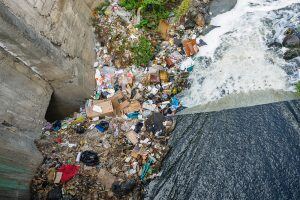 It is much more expensive to ship industrial waste to landfills or to incinerate it than it is to recycle. Costs include tipping fees, which are required at regulated landfills (measured in price per ton), and hauling and off-loading expenses. Protecting the surrounding environment is costly, too!
According to the Environmental Research and Educational Foundation located in Raleigh, NC, from 2016 to 2020, average annual tipping fees increased by 4.4 percent in both the Pacific and Northeast, 2.7 percent in the Mountains/Plains, 5.6 percent in the Midwest, 1.1 percent in the Southeast, and 2.82 percent in the South Central region.
Tipping fees, mileage, and contaminants, such as food residue that makes recycling difficult, all contribute to why traditional waste management services’ annual price increases are as high as 20%, causing your bill to climb along with the landfills!
KenBay adds value to your zero waste landfill initiatives
The KenBay Rotopac rotary industrial trash compactor compresses waste into 4’ cubed bags, enabling haulers to move more waste to recycling centers, waste-to-energy facilities, or incinerators. These stackable bags are superior to transporting roll-offs and receiver cans that contain considerable amounts of air. RotoPac’s unique rotary arm compactor crushes your trash six to eight times before it’s shipped.
Reasons to try the KenBay RotoPac for your trash compactor waste removal needs
- Reduces your costs of transporting waste to recycling and waste facilities
- The small footprint (4’ x 5’) allows for strategic placement
- The high compaction rate means you are shipping waste, not air
- You improve your company’s safety compliance when you minimize waste material handling
- Biodegradable bags are available for use with the RotoPac
- We are the only U.S. supplier of rotary continuous compaction machines
In addition, for recyclables, KenBay offers the KB-42 baler and a variety of other balers for recyclables, and a selection of trash compactors for situations when RotoPac is not the best solution.
Want to know how much you could save on industrial trash compactor waste removal by using the RotoPac? Check out our easy calculator!
The Bright Future of Waste Management
Why You Need to Know Your Local Industrial Waste Regulations