
By KenBay on Sep 17, 2021, 3:56:18 PM
Trash Compactor Safety
When it comes to industrial trash compactors, safety is a top priority. Purchasing a compactor with high safety ratings provides two primary benefits. First, it provides potential savings on insurance and personal injury claims, and second, it can reduce plant downtime.
Trash Compactor Safety Requirements By OSHA Standards
OSHA General Industry Standard guidelines are to be followed for the proper maintenance of any industrial waste compactor.
Each authorized employee needs to receive the necessary training in a number of different disciplines. There are three disciplines employees should train in.
- the recognition of applicable hazardous energy sources
- the type and magnitude of the energy available in the workplace
- the methods and means necessary for energy isolation and control
The KenBay RotoPac industrial waste compactor was designed with all of these disciplines in mind. It is considered one of the best commercial trash compactors on the market. Companies prefer the KenBay model due to its prominently placed isolator switch as well as other safety mechanisms inimical to its design.
Using OSHA metrics, KenBay works diligently to meet standard trash compactor safety requirements
Safety by Authorized Staff
Authorized personnel who have been properly trained should be the only staff members allowed to operate the trash compactor. Employees who work in the vicinity of the trash compactor must be trained to ensure all safety precautions are taken during the course of the workday to keep all workers safe. Visitors should not be allowed near heavy equipment at any time.
Other Safety Concerns
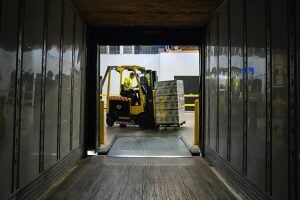 Substantially reducing forklift traffic in the disposal of waste in any facility is also a significant safety concern. The KenBay RotoPac industrial waste compactor is designed to take up minimal space, allowing it to fit in seamlessly on almost any facility floor.
Additionally, workplace accidents due to improper forklift use are also costly. Regardless of facility size, forklift traffic is always a safety consideration. Forklift traffic can be entirely eliminated by taking advantage of the RotoPac’s continuous compaction capability in putting the waste directly into it from the machine producing it.
The waste can be input into the top of the RotoPac via a chute or by conventional conveyer or pneumatically blowing it into this industrial trash compactor. Cutting out the forklift could be your first step toward better facility safety.
Additional Safety Features – Emergency Stop Button
Wearing proper PPE, like gloves and safety glasses, is highly effective in protecting against cuts and abrasions when loading waste material into an open top trash compactor. Earplugs, hard hats and safety goggles should be worn, if recommended by the manufacturer or required by the employer.
Also, locating the start button and other operating controls are positioned so that the user engaging in and controlling the RotoPac’s operation can’t reach into the compaction chamber while disposing of industrial and facility generated waste.
Further, the E-stop (emergency) button is placed for easy access should someone need to quickly disengage the compactor’s operations. The control displays are placed to be easily visible and accessed by anyone putting waste into the RotoPac industrial trash compactor. Making sure the door of the compactor is shut before operating the equipment and never opening the door when the compactor is in operation.
Trash into a Rotary Compactor
The method used to prepare the waste before it enters the compaction chamber of the rotary arm has safety implications as well.
For example, cardboard boxes should not be broken down by a sharp tool before entering the RotoPac. Even large cardboard boxes should be folded instead of cut before entry. Large plastic sheets should be gathered into balls in order to reduce the chance of dragging a foreign object, such as a cutting tool, into the compactor.
Via a Chute
The chute is another important factor to consider when maximizing safety. The RotoPac has provided a chute using the loading door so that when it is opened, the compaction chamber is not exposed to the operator.

The sides of the RotoPac industrial waste compactor are steel slabs making it impossible to climb the sides to enter waste into the top manually. The loading door can also be locked so that only authorized personnel may use the compactor. The RotoPac also provides an option for when the compactor is operating while the loading door is locked. Some companies require this feature.
Waste-to-Energy Safety and Cost Savings
The ultimate goal and purpose of a company owning and using an industrial waste compactor is to reduce the cost of hauling waste to its ultimate destination (whether it be to landfill, recycling operations or a WTE firm).
Simply stated, the more densely the waste is compacted the less frequently the waste hauling trucks enter the premises; thus, reducing the chance of causing a harmful accident. The waste compacted by a RotoPac is done so polyethylene bags that are easily sealed avoid any harmful odors emanating from the waste. Also, with the bags sealed, waste will not blow off the truck. This reduces the chance of a potential accident while the waste is being transported.
Overall, the KenBay was designed with the trash compactor safety checklist in mind. It aims to save costs by reducing the potential for harmful accidents.
Proper Intervals for Maintaining Your Industrial Trash Compactor
KenBay – Always Improving