
By KenBay on Mar 22, 2022, 9:11:51 AM
Did you know that the U.S. produces as much as 7.6 billion tons of industrial waste every year? Of course, all of those waste materials need somewhere to go. Most of it ends up in Class 3 municipal solid waste landfills. As of 2018, there were approximately 1,269 in the continental United States, all managed by the states where they are located.
What is a Class 3 landfill?
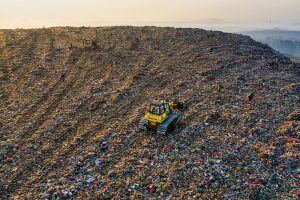 A Class 3 landfill is a scientifically engineered waste disposal facility that is designed to hold waste and isolate it from the environment. Strict federal and state regulations govern the location, design, and operation of Class 3 landfills to protect people and the local environment.
Many factors determine how long a landfill will be operational, but weight and space are by far the most important. Each year, the remaining capacity and life expectancy of a landfill are calculated using the amount of waste deposited over the last 12 months.
Municipal landfills are only allowed a certain amount of waste each year. In addition, each vehicle that comes to the landfill can only carry an average of about 12 to 14 tons. More than 200 trucks and other waste management vehicles might come to a municipal landfill each day, delivering more than 2,800 tons of trash. Those numbers can add up quickly.
How trash is compacted at a Class 3 landfill
Here’s how the process works. Waste is dumped into an area of the landfill called a cell. Most Class 3 landfills have one cell open at a time, but fully operational landfills are usually building another cell before the current one exceeds its limits.
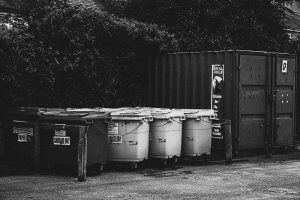 The amount of space in a landfill is directly related to its capacity and usable life. Therefore, if you can increase the space, you can increase the usable life. This is where crushing waste through an industrial trash compactor comes in. In addition to conserving landfill space, industrial trash compactors can minimize your carbon footprint and increase your return on investment.
After the waste is unloaded, a 100,000-pound tractor with spiked wheels goes back and forth over the garbage to crush as much air out of it as possible. On average, about 1,200 to 1,400 pounds of garbage can be compacted into one cubic yard of space. At the end of the day, the cell is covered with a layer of soil or other material to minimize odor, prevent infiltration by pests and rodents, and break down the non-solids.
To improve the rate of compaction, industrial waste managers are encouraged to use a trash compactor before the waste even arrives at the landfill site.
With the benefits that they afford those in the waste management industry, it’s no surprise that the 2022 waste compactors market outlook is strong. According to the Global Trash Compactors Market 2022 Research Report, the global trash compactor market will reach $347.5 million by 2027, up from $282 million in 2020.
The industrial waste disposal process
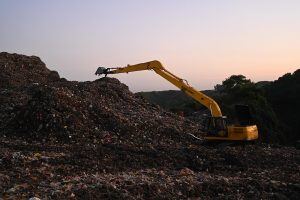 The Environmental Protection Agency has guidelines for landfill sites beginning with the bottom liner system, which includes two feet of clay, a polyethylene liner, and a protective layer of sand, all of which keep waste from touching the groundwater. The stormwater drainage system includes plastic drainage pipes that collect the rainwater that has not been in contact with the garbage and directs it to a retention pond.
The leachate collection system collects rainwater or other liquids that did come into contact with waste and gathers contaminates, treating it so it won’t harm the groundwater.
A methane collection system collects the methane gas created by decomposed garbage and breaks it down with the help of bacteria, creating half methane/half carbon dioxide with minimal amounts of nitrogen and oxygen. Flammable methane gas is a continual hazard because of its toxic nature.
The Environmental Protection Agency requires all U.S. municipal solid waste landfills to be covered with at least 24 inches of earthen material, six of which must be able to sustain plant growth. Lastly, the final cap or cover is placed on the Class 3 landfill and it is closed. The covering seals the waste from the air and reduces seepage into the landfill.
KenBay Smart Industrial Waste Compactors: Increasing the life of landfills
The KenBay Industrial Waste Compactor has extensive benefits for your company’s landfill reduction initiatives. The RotoPac industrial trash compactor compresses waste into 4’ cubed bags. By reducing the size of your waste, you are improving your ROI with your waste hauler, helping to conserve landfill space, minimizing your carbon footprint, and ultimately saving money! Contact us to learn more.
What if Waste is the Source of Your Waste in Lean Manufacturing?

How Improper Industrial Waste Disposal Affects Humans and the Environment